
When “Dry Rot” Was Really Termites: A Holiday Crawlspace Story


About the Author: Jameson Elam is the owner and operator of Good Sense Termite, serving Alameda, Santa Clara, San Mateo, and Santa Cruz counties. With over 14 years of hands-on experience in the termite control industry, Jameson specializes in thorough inspections, accurate diagnostics, and long-term solutions tailored to California homes. His deep knowledge of local termite behavior and building structures has made Good Sense Termite a trusted name for homeowners and real estate professionals alike.
A House Getting Ready For The Holidays

On the surface, everything looked fine. The family was getting ready for the holidays, making guest lists and menus. The home felt solid and cozy.
What nobody could see was that under the floor, in a crawlspace no one visited, a problem had been growing quietly for quite some time.
This is the story of how “dry rot” turned out to be termites, how one inspection missed what mattered, and what finally fixed it.
March 2024: The “Dry Rot” Repair

In March 2024, the family noticed a soft spot in the floor. A section felt spongy and slightly uneven.
They called a contractor, who pulled up the damaged boards. Underneath, the wood looked dark and compromised. The working assumption was dry rot from moisture, so the solution was simple:
Remove the damaged wood
Repair the area
Put in new flooring
No termite inspection was requested. No one went into the crawlspace. The visible problem was handled from above, while whatever was happening below remained untouched.
March 2025: The First Termite Inspection

About a year later, in March 2025, the homeowners still felt something was not quite right. The floor did not feel as solid as they expected after a recent repair. There were small signs around that same area.
They did the right thing and called a termite company.
Here is what happened:
The inspector walked the exterior and parts of the interior
He looked at some accessible areas
He did not fully inspect the entire crawlspace
His written report listed Drywood termites
It also listed parts of the crawlspace as “inaccessible”
The key problem: he did not clearly explain to the homeowners that the crawlspace had not been fully inspected. The family left that visit thinking they had a solely a drywood termite issue, not a larger Subterranean problem below.
The colony under the house stayed active.
November 2025: The Week Before Thanksgiving

The week before Thanksgiving, the house should have felt festive. Instead, the family noticed winged insects indoors, right around the area where the floor had been “fixed” the year before. At first it was a few. Then more appeared.
They were worried about:
Guests seeing insects during the meal
What this meant for the home’s structure
Why the earlier “repairs” did not seem to hold
This time they called Good Sense Termite.
What Good Sense Found Under The Floor
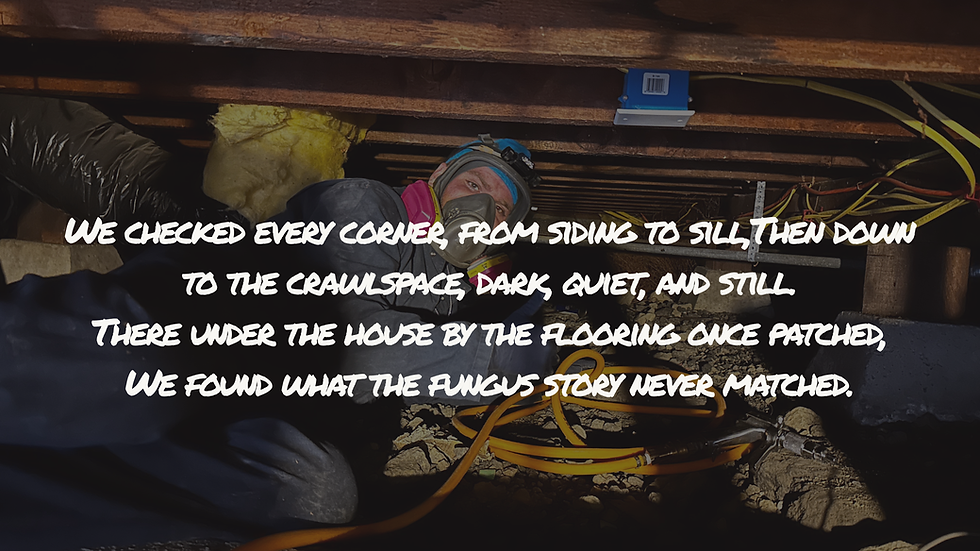
When our inspector arrived, the goal was not just to clean up swarmers. It was to find the source.
We:
Inspected the exterior and foundation lines
Revisited the area of the earlier floor damage
Entered and fully inspected the crawlspace, not just near the hatch
In the crawlspace, directly under the formerly “dry rot” section, we found:
An active Subterranean termite infestation
Termite damage that lined up with the previous floor problem
Clear evidence that this had been active for some time
The soft floor from 2024 had not been only rot. The earlier inspection that listed partial crawlspace access had not reached the real problem area.
We created a treatment plan to eliminate the Subterranean colony and protected the structure so this would not keep repeating.
Dry Rot vs Termite Damage: Why They Get Confused

Dry rot and termite damage often show up with similar symptoms:
Floors that feel spongy or uneven
Crumbling or brittle wood when exposed
Discoloration around baseboards or trim
The causes are very different:
Dry rot is a wood-decaying fungus that grows in damp conditions and breaks down wood fibers
Termites are insects that eat wood from the inside, often leaving only a thin surface layer
A contractor can be excellent at repairing wood, but might not be trained to tell the difference between fungal decay and insect damage. That is where a licensed termite inspector comes in.
Any time you are opening up walls, floors, or framing, it is wise to ask:
“Does this look like termites?”
“Should a termite inspector take a look before we close it back up?”
Catching the real cause early can save thousands in repeated repairs.
Why Crawlspace Access Is So Important

Subterranean termites commonly show their first signs underneath the home, not inside living spaces. That is why crawlspaces are so critical.
In this case, the earlier inspector:
Did not fully inspect the crawlspace
Marked sections as “inaccessible” on the written report
Did not clearly explain this to the homeowners during the visit
From the homeowner’s view, it felt like the house had been inspected. In reality, one of the most important areas had not been checked properly.
A thorough inspection should:
Attempt crawlspace access wherever safe and practical
Document any areas that cannot be accessed
Explain, clearly and in plain language, what “inaccessible” means for the overall risk
When we inspect, we treat crawlspace and attic access as a core part of the work, not an optional extra.
What Homeowners Can Learn From This Holiday Case

You do not need to crawl into your own subarea or learn every detail of termite biology. A few practical steps go a long way:
1. Ask clearly: “Will you inspect the crawlspace and attic?”
If the answer is “no,” or it sounds unsure, you deserve to know why. In homes with raised foundations, a full opinion without a crawlspace view is often incomplete.
2. Ask: “If any area is inaccessible, will you tell me in person?”
You should hear it directly, not just see it in small text on a later report. That gives you a chance to ask whether access can be created or improved.
3. During repairs, ask: “Could this be more than dry rot?”
When contractors remove damaged wood, it is the perfect moment to involve a termite inspector if there is any doubt at all.
4. Trust your sense that “something feels off”
In this story, the homeowners had a feeling months before the swarm. Even if you do not see insects, a free inspection is a low-cost way to either confirm a problem or get peace of mind.
FAQ
Q: Is it common to first notice termites right before a holiday?
It happens more often than you might think. People are home more, cleaning and decorating, and paying closer attention to small changes indoors. Swarmers inside are a sign that a colony is active in or near the structure.
Q: If a report says “inaccessible,” is that a problem?
Not always, but it is important. Ask which parts could not be inspected and why. Sometimes a small change, like cutting a new access panel, or moving storage elements can allow a proper follow up look.
Q: Can Good Sense inspect my home if I already had another company out this year?
Yes. We often review existing reports, then perform our own full inspection and explain what we see. Never feel afraid to get more than one opinion!
A Better Ending For One Home, And A Simple Start For Yours
For this family, the story ended with a clear answer and a solid plan. The Subterranean termites under the house were treated, the structure was protected, and future inspections are now part of their routine.
You do not have to wait for a swarm before you act. If a floor feels wrong, if a past report left you confused, or if you simply want to know what is happening under your home before guests arrive, we are ready to help.
Real thorough inspections. Real, straightforward answers. It's just Good Sense.


Comments